Institute radio astronomers
Serious MenThe Institute radio astronomers are both a scientific community and an informal political faction inside the Institute of Theory and Research. Gathered around Jana Nambodri, they first fail to win an autonomous department for Search for Extraterrestrial Intelligence (SETI), then become an increasingly visible constituency in the Institute’s struggle over leadership. Their story is not simply one of a scientific program gaining recognition: it shows how collective support, professional grievance, and control of institutional space help determine who can direct the work.
A scientific circle becomes a faction
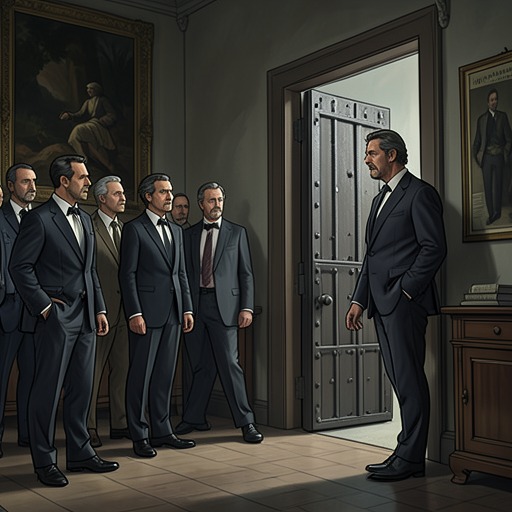
The group is shown in meetings and shared offices rather than introduced through a formal membership list. Nambodri is its central figure, surrounded by colleagues who gather with him to discuss the Institute’s affairs. After their attempt to establish SETI as an autonomous department fails, they meet in his office more often. Their lament takes on the appearance of hopeful conspiracy, suggesting that scientific disappointment has become a basis for political solidarity. On one such morning, six people, including Nambodri, are in the room when he receives a phone call that leaves him speechless.
Their collective identity takes shape against the authority of Arvind Acharya, the Institute’s director and leader of the Balloon Mission. The contrast is visible before it is openly declared. In a meeting where Nambodri speaks about privilege, caste, his difficult childhood, and his work, Acharya interrupts to ask about Nambodri’s stated IQ of 140. The room responds with nervous laughter, uncertain whether Acharya is joking. The exchange gives the radio astronomers a glimpse of the director’s power to unsettle a discussion, while also exposing the tension between Nambodri’s self-presentation and Acharya’s scrutiny.
The challenge to Acharya
Nambodri eventually makes the group’s opposition explicit, arguing that the Balloon Mission should not be the Institute’s sole priority. As the radio astronomers prepare to confront Acharya over the proposed SETI department, Nambodri wants them to adopt an aggressive stance. Yet when Acharya enters, one scientist rises impulsively, undermining that planned show of defiance. The others study the table rather than meet his gaze. Their hesitation registers how difficult it is to challenge a director whose authority has long shaped the institution.
The attempted power shift is therefore neither effortless nor unanimous in its visible gestures. Nambodri is unsettled by Acharya’s calm, while Acharya quickly takes command of the meeting, interrupting Bhaskar Basu before he can proceed. The group’s presence in the room does not itself secure the outcome it wants. Its significance lies in the fact that opposition has become organized: the radio astronomers are there as a bloc, and their failed effort to make SETI independent will be followed by a deeper contest over leadership.
Grievance and the inquiry
During the inquiry into Acharya, the case against him changes course. After Oparna Goshmaulik leaves, postdoctoral students connected with the Balloon Mission enter nervously but do not pursue the case. The jury sets aside the sampler allegations and hears instead the complaints of thirteen scientists who say that Acharya mentally tortured them. The Institute radio astronomers’ wider opposition gains force in this climate of grievance, though the account does not identify all thirteen complainants as members of the group.
Nambodri understands the complaints as part of a broader revolt by ordinary colleagues against a celebrated figure whose high standards and refusal to offer false compliments have alienated people around him. The group’s political advantage does not depend solely on proving the sampler case. In Nambodri’s reading, Acharya has accumulated opponents, including people who once admired him; professional resentment and his fall from favor make the inquiry a route to power. This is the faction’s decisive opening, even though its support does not make every allegation against Acharya certain.
The new administration and its limits
At the Institute gates, Basu announces that the internal inquiry is over, that Acharya has confessed to ordering falsification of the research, and that he is suspended. Basu also lists alleged misuse of Institute funds and other misconduct, then names Nambodri acting director. The announcement is followed by a visible change in the group’s standing. As Nambodri and Basu walk to the director’s office, scientists emerge from their rooms; some nod, many watch bleakly, and a number follow the pair. An old number theorist hands Nambodri an envelope and says he is quitting. The procession ends in applause as Nambodri enters the office.
The change of administration is material as well as official. Acharya’s framed film posters are moved, his office is rearranged, and the radio astronomers make the white sofas their working base, spending the day there against the backdrop of the Arabian Sea as they plan their future. They no longer have to wait in Ayyan Mani’s anteroom: colleagues can go straight in to see the new director. Their glances at Ayyan as they bypass his clerical authority convey a simple triumph, while the altered room makes their new access visible.
The group later appears in public as part of a national presentation on extraterrestrial life. Nambodri arrives with four colleagues and announces that the Giant Ear will scan the skies for signals from advanced civilizations. Other radio astronomers speak about the importance of youth in SETI. The failed campaign for an autonomous department has thus given way to a program publicly represented under Nambodri’s leadership, although the evidence does not establish that every institutional dispute has been resolved.
Nor does the new order erase the past. When Acharya later arrives during a gathering on the sofas, the radio astronomers initially feel a familiar terror before recognizing that the former director is no longer in command. He cannot make sense of the rearranged room; Nambodri rises and ushers him to a vacant place. The welcome is gracious, but the scene preserves the group’s memory of Acharya’s former authority even as it shows that the hierarchy has changed. Across these episodes, the Institute radio astronomers serve as a collective measure of that reversal: hesitant under Acharya, emboldened by his suspension, and newly empowered without becoming free of the history that binds them to him.